Artists, what did we do ‘when the shit was going down?’
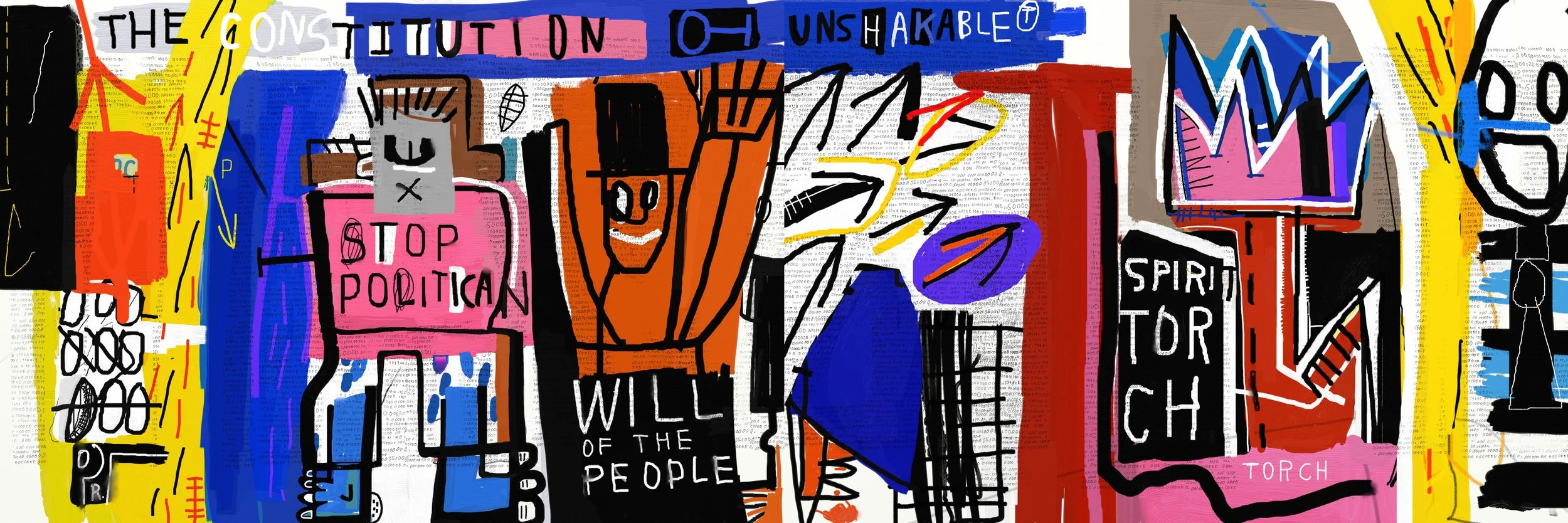
Grafitti by Moypapaboris
Historically, art has played an important role in disrupting fascist regimes—and this remains true under the Trump administration
By Jesús Iñiguez, Prism
I went to Las Vegas last month for the Latin Grammy Awards, attending various events and showcases featuring musical acts and artists. It’d been years since I visited Sin City, but I can’t recall it ever feeling so flat and sleepy. While there were people walking along the Las Vegas Strip, the sights and sounds seemed muted and dim. Big names in the Latino music markets were all making landfall in this desert oasis of excess, yet none of it seemed to register.
One event put me on the third floor of the Hard Rock Cafe for a mimosa brunch. After some announcements and a DJ set, Peruvian duo Alejandro y María Laura took the stage to play a short, celebratory set marking their first Latin Grammy nomination.
The married couple’s repertoire consisted of ballads and love songs, with María Laura on lead vocals and Alejandro accompanying her on guitar. Before they played their last song, Alejandro provided context for their final composition.
As artists, Alejandro said they felt compelled to speak out about the inhospitable nature now prominent across the U.S. under the Trump administration, especially as it relates to Latinos. He mentioned that as a duo, they felt a responsibility to call it out—even during their small brunch presentation, as the heaviness of it all permeated everything, everywhere.
Then, Alejandro and María Laura reminded all of the artists in the room that they all have different audiences and platforms, and while the administration relies on our immediate submissive compliance, it is the duty of artists to speak truth and disrupt oppressive agendas targeting our communities. After all, if we’re not motivated by truth, what is the purpose of having a voice and creating art? Alejandro y María Laura then launched into “El Rio No Tiene Culpa,” a poetic protest song.
The feeling in the room immediately shifted; all eyes and ears were now paying attention to the stage. I realized they were right. There was an omnipresence in the room, sulking in the background. The song was like lit sage. As the notes curled out of Alejandro’s guitar, it almost seemed as if the giant elephant in the room was being outlined for us to see while María Laura’s vocals gently guided it out the door. The space was being cleansed and reclaimed, even if just for a few moments. We were all reminded of our duty as artists and what was at stake if we failed at our mission.
There’s no sense in sugarcoating our current situation: We are neck-deep in a flooded zone. Many are having a hard time treading water while the stronger swimmers give the rest of us confidence. And it’s in these times of despair that artists conjure Nina Simone, who also told us it was our duty as artists to reflect the times, a mantra that has served, centered, and focused many of us.
As a videographer and photographer, I’ve been in artist circles for a significant portion of my life. For around 15 years, I’ve created bodies of work around the undocumented experience in the U.S., collaborating with countless like-minded artists. And I’ve seen their cultural power rise and inspire.
But as I see masked, deputized men kidnap and disappear people off the streets, I can’t help but think of a line from comedian Richard Pryor’s standup routine about fear, positionality, and contribution: “What scares me is that one day my son will ask me, ‘What did you do, daddy, when the shit was going down?’”
Immigration and Customs Enforcement (ICE) is now flush with a budget larger than most world militaries, the FBI and the Department of Justice have been co-opted by Donald Trump’s henchmen, and the Supreme Court is abusing the shadow docket to rubber-stamp the Heritage Foundation’s Project 2025 extreme right-wing agenda. Billionaires are cozying up to the Trump administration, with Vice President JD Vance implementing the wishes of technocrats such as Peter Thiel. There is plenty of cause for concern and fear. Still, despite what feels like an insurmountable fight before us, none of these agencies or players frighten me.
What scares me to death is not having an answer when future generations ask: What did you do when the shit was going down?
I don’t think I’m alone in this sentiment. The idea of legacy drives many artists. Even though we’re currently in the middle of an onslaught of procedural, systemic shifts that make many of our lives harder, this is a cultural war in which we’re all engaged. Bureaucracy crawls, culture flies. So in order to codify systemic shifts, the culture has to accept it. The Trump administration knows this, which is why it’s gone on the offensive, co-opting platforms to spread its rhetoric and propagandize its vision for what the U.S. should be.
But if we look at the administration’s creators and cultural ambassadors, it’s clear the Trump administration knows that it’s not equipped to stand toe-to-toe with artists who have a conscience.
Artists are often the last people to bend the knee, if ever at all—and they remind others that they, too, can fight back.
True art takes courage, and courage is the praxis of hope. It’s what allows us to make calculations about potential failures and yet still leap into the unknown. Beyond art, love, job interviews, a presentation in front of peers, or even closing on a house, courage is what helps manifest a way forward. And courage requires vulnerability. This is why vulnerability in art resonates so deeply with an audience; it’s relatable to all with a human spirit. This is also why when you reach people through art, you can actually touch their hearts and maybe even change their minds. Historically, this is why artists and cultural workers are dangerous to fascist regimes. Artists are often the last people to bend the knee, if ever at all—and they remind others that they, too, can fight back.
I don’t think it’s too much of a stretch to theorize that this is perhaps one of the main reasons why AI companies have focused so much of their attention on teaching their “machine learning tools” to study and emulate human art. Because if, with just a few prompts, AI can generate images that can then be disseminated across social media as a form of propaganda, technocrats can erode the power of artists. In the frontlines of this culture war, art is all that’s left.
So what does it say when the Department of Homeland Security (DHS) uses AI-generated imagery to propagate and proliferate the administration’s anti-immigrant agenda? That they use pop music in their propaganda videos without first consulting artists, never once asking for permission or even apologizing after artists demand the removal of their work? It says that for the most part, the fascist regime has been unable to find artists to create on its behalf.
Artists with any real influence imagine a different future. They iterate and build instead of destroy. DHS content, on the other hand, features disposable memes and AI “art” that calls for destruction, pushing extremist neo-Nazi rhetoric to the forefront for white supremacist acclaim and consumption. And though it may work as rage bait or speak to a limited population who believe the propaganda, the content has no real value, substance, or future. It does nothing beyond sparking a momentary reaction. Like DHS Secretary Kristi Noem’s face, these AI renditions speak volumes about the soulless inhumanity of the Trump administration.
Across pop culture, we see the response to the Trump administration’s actions. This is likely why the outspoken Bad Bunny was chosen to perform at this year’s Super Bowl, despite the phenomenal right-wing meltdown it caused. It’s also likely why Sydney Sweeney, American Eagle’s “good-genes” darling who happily blew a racist dog whistle and overnight became a white supremacist ambassador, is a box office flop. In this free market, artists who stand for the freedom and respect of their communities are beloved enough for their fans to show support with their wallets, forcing organizations such as the NFL to listen. Artists who align themselves with the current administration aren’t even backed by their own supporters.
It’s important to note that artists don’t need a massive platform in order to hold the line and contribute to the discourse of resistance. At the local level, there is an army of artists working nonstop to document the ongoing atrocities and use cultural organizing as their response. They’ve been ready for this. Many first sharpened their skill sets during the Obama administration’s mass deportations. Barack Obama was the midterm, the Trump administration is their final exam—and they aim to pass with flying colors.
They are graphic designers, printmakers, comedians, photographers, writers, musicians, chefs, and more. Artists of all different backgrounds, disciplines, and experiences, from every corner of this country.
They’re creating the visual language of resistance. They’re ideating with organizers to stage demonstrations outside of ICE headquarters and National Guard deployment areas while wearing inflatable costumes, reinforcing the absurdity behind DHS’s messaging about “the enemy within.” They’re artists such as Ernesto Yerena, who are methodically creating culturally sensitive posters and handouts that advise residents about their rights if and when they encounter ICE. They are musicians such as Snow Tha Product, who are creating music calling out members of their own communities for voting against their own interests, and delivering accompanying comical yet poignant music videos that have racked up millions of organic hits in a matter of days—something that Trump’s propaganda machine routinely fails to do. They are artists such as Johanna Toruño who wheatpaste posters in their own communities to uplift and encourage, and anonymous graffiti artists who spray paint more brash and direct messaging. There are thousands of these kinds of creatives all across the country, and they work hard to make sure the current administration’s narrative doesn’t go uninterrupted—no matter the power the administration’s billionaire backers have to silence or disappear them.
Most importantly, artists are encouraging us to visualize what our future can be. The Trump administration’s chaos is indeed by design, aimed at overwhelming us and damaging our communities and our sense of belonging and safety. And with the onslaught of it all, we’ve all been on the defense, getting very good at saying no—no to having our neighbors targeted and kidnapped, no to allowing federalized goons to operate in our neighborhoods in peace, no to patronizing corporations that support the Trump administration, no to allowing our communities to be divided and conquered. But we also have to learn to live in our yes. What are we denying ourselves by living in fear? What brings us joy? What inspires? What does it mean to be healthy?
Even during these times of uncertainty and chaos, it would do us all good to identify not just what we’re fighting against and fighting for, but also: What does the world look like that we want to build toward? While DHS’s propaganda pushes for a past that never really existed, artists must push for a collaborative and functional future of equity and liberation that we know is possible.
We know it’s possible because artists are merely reflecting the discourse, traditions, and values of our communities, and then refining those ideas and making them palatable for those who don’t have imagination and feasible for young visionaries ready to take the next steps.
Artists are the pollinators of culture and truth. It is in our best collective interest to keep these cultural bearers at the table when strategizing for our future. Because if we don’t allow artists to remind us of where we’ve been and to show us the way forward, there will be no coming back from Trump’s America that is devoid of humanity—and what an utterly boring, homogenous, and obnoxious world that would be.
Editorial Team:
Tina Vasquez, Lead Editor
Carolyn Copeland, Top Editor
Stephanie Harris, Copy Editor
Prism is an independent and nonprofit newsroom led by journalists of color. We report from the ground up and at the intersections of injustice.